
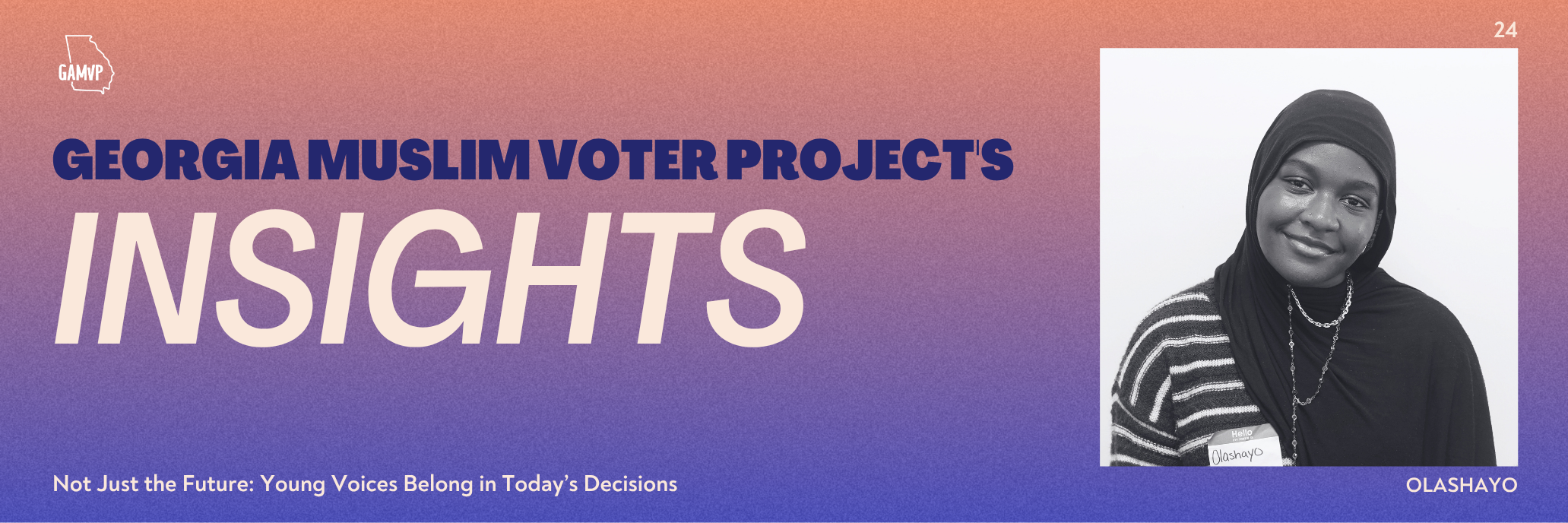
My journey into civic engagement did not come all at once. It grew slowly, starting from the moments when I realized how often young people, especially young Black and Muslim voices, were left out of conversations that directly impacted our lives.
I grew up watching decisions get made about us without anyone ever thinking to ask us. Whether it was school zoning discussions, youth programs being cut, or debates about community safety, I kept seeing the same pattern: adults made choices, and young people were expected to simply adjust. Over time, that pushed me to speak up, and it is what eventually led me to the work I do with the Georgia Muslim Voter Project today.
My advocacy started at the local level. I served on the Youth Commission, where I learned how policy actually touches everyday life. One of my earliest lessons came during zoning conversations that seemed boring on the surface until I realized they determined who had access to resources, libraries, transportation, and opportunities. Those conversations helped me understand how systems shape neighborhoods, and they pushed me to look more closely at who gets a seat at the table and who does not.
Eventually, that curiosity turned into action. I began organizing, asking questions, and making sure young people were not just spoken for, but listened to. Along the way, I found the same thing again and again: people wanted to participate, but they did not always know how. That is where GAMVP became such an important part of my story.
Working with GAMVP gave me a space where my identity, my voice, and my commitment to justice could coexist without feeling too young or too political. Whether I was helping teens register to vote for the first time, explaining the difference between early voting and Election Day, or breaking down why local elections matter, I felt the impact of showing up. Sometimes it is a small moment, like someone realizing their district changed, or a student understanding why civic engagement is more than a checkbox. Other times, it is big, like watching a friend or community member vote for the first time because I took the time to walk them through the process.
What drives me most is the belief that young people deserve to feel like this democracy belongs to us too. Our voices are not just the future. We are part of the present, and the decisions happening today shape the world we are inheriting tomorrow. Civic engagement is how I make sure the issues I care about, including equity, education, safety, and representation, are not just talked about but acted on.
As I continue this work, my hope is simple. I hope that more young Muslims see themselves not only as voters, but as leaders in shaping our collective future. Advocacy is not reserved for adults in suits. It starts with anyone who is willing to show up, ask questions, and refuse to stay silent.
If we keep engaging, keep educating, and keep lifting each other up, we can build a Georgia and an America where every voice truly counts.